
Here's the story we hear almost every month.
A homeowner on Chestnut Street goes out of town for a long weekend. A pinhole leak in an aging galvanized supply line behind a laundry wall finally gives way. By the time they're back Sunday night, a thousand gallons have soaked through lath-and-plaster, pooled on original Douglas fir flooring, and dripped down into the kitchen ceiling of the unit below. The claim is somewhere north of $40,000 between the drying, the plaster, the floors, and the neighbor's kitchen.
The insurance company pays once. Then, at renewal, they send a letter. You need an automatic water leak detection valve installed on the main within 60 days, or we won't renew your policy.
This is increasingly the story for San Francisco homeowners. Farmers, State Farm, Chubb, and PURE are all tightening requirements. The irony is that the valve they're demanding, a device that would have prevented the claim entirely, typically costs $1,000 to $1,500 installed. The question is whether you want to install it before the flood or after.
Why insurers are getting pushy (and why California especially)
Water damage is now the most common and most expensive non-weather homeowner claim nationally, and California carriers have been tightening up fast:
- Farmers Insurance has been requiring Moen Flo Smart Water Monitor + Shutoff devices at renewal on California homes older than 30 years with plumbing that hasn't been updated in the last 20 years. That description fits a huge share of San Francisco's Victorian, Edwardian, and mid-century housing stock. They're also requiring them on any home with a replacement value over $1 million.
- State Farm now requires automatic shutoff valves on California policies with replacement costs of $2–4 million, down from a previous $1.5 million threshold for secondary homes only.
- Chubb, PURE, and other high-net-worth carriers have been requiring them on all new policies above certain replacement thresholds for several years.
If you haven't gotten a letter yet, there's a good chance you will on your next renewal, especially if your home is older than 30 years, recently had a leak claim, or sits at the bottom of one of San Francisco's high-pressure hill zones.
Insurance discounts range from 5%–15% on annual premiums once a monitored valve is installed, and some carriers offer deductible reimbursements on top. Over a few years of premium discounts alone, the device often pays for itself.
What these valves actually do
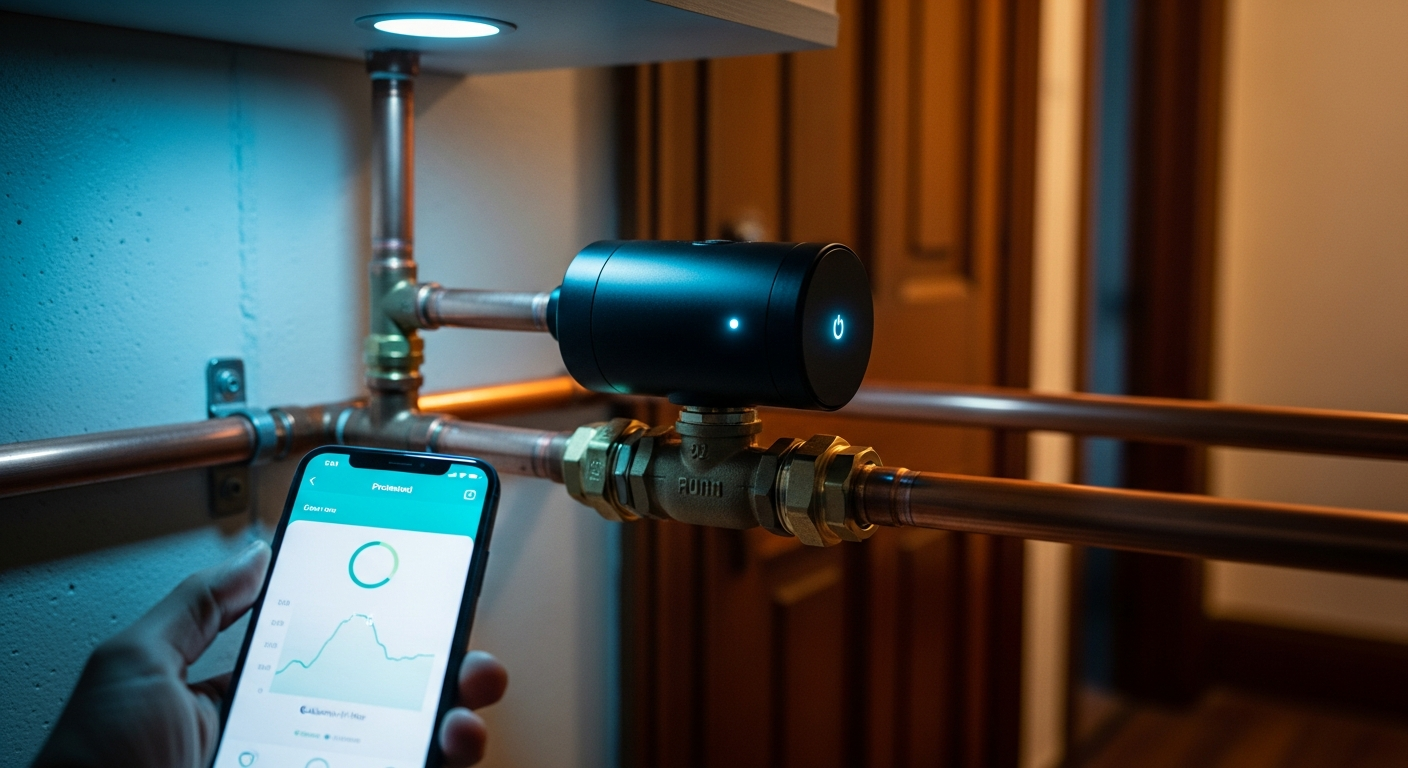
A "smart leak shutoff valve" isn't just a leak sensor. It's a motorized ball valve plumbed into your main water supply line, paired with a flow sensor and a cell/Wi-Fi-connected brain. It does four things:
- Monitors every drop of water leaving the main, 24/7.
- Learns your normal usage pattern over a few days to a few weeks.
- Alerts you (push notification, text, email, and on some systems a robocall) when something looks wrong: a hose bib left on, a toilet flapper running, a slow drip, or a catastrophic burst.
- Shuts the water off automatically at the main when a leak is confirmed, so that thousand-gallon disaster becomes a ten-gallon mess.
Most units also include remote shutoff from your phone. Useful when you're at SFO about to board a flight and realize you're not sure if the upstairs bathtub was draining slowly.
The contenders, honestly compared
There are roughly five devices that matter in San Francisco right now. Here's how they actually differ.
1. Moen Flo (now "Moen Smart Water Monitor + Shutoff")
- Street price: ~$400–$500 for the device
- Install: typically $500–$800 on a standard residential supply line
- Best for: the broadest insurance recognition, simplest app experience, homeowners who want set-and-forget
- Strengths: Moen's app is the easiest to use of the bunch. The device learns fast: roughly a week of background monitoring before it starts catching anomalies. Insurance carriers are most likely to immediately accept a Moen Flo without back-and-forth, because every major carrier already has it in their approved list. Alerts include an actual robocall on large events, which is much harder to sleep through than a push notification.
- Weaknesses: The reporting is shallow compared to Phyn. Some features are paywalled behind a $5/month FloProtect subscription (extended warranty, deductible reimbursement, premium alerts). Uses a turbine-style flow sensor, so more moving parts than competitors.
2. Phyn Plus (2nd Gen)
- Street price: ~$580 for the device
- Install: typically $600–$900, though professional Phyn partner installers sometimes bundle setup at $3,000–$5,000 for large homes
- Best for: homeowners who actually want the data, and homes where detection accuracy matters more than ease-of-use
- Strengths: An independent Utah State University study ranked Phyn Plus #1 for leak detection accuracy, ahead of Moen, Buoy, StreamLabs, and Flologic. Phyn uses ultrasonic pressure-wave analysis instead of a mechanical turbine, which means no internal moving parts, less wear, and the ability to detect leaks as tiny as a single dripping faucet while the rest of the house is asleep. The app's reporting is deep: daily, weekly, and monthly water-use breakdowns by fixture category.
- Weaknesses: A roughly 1,000-hour (six-week) learning period during which you'll see more false alarms and unexpected shutoffs. The app is powerful but more complex than Moen's. Insurance recognition is strong but slightly less universal than Moen Flo.
3. FloLogic
- Street price: ~$900–$1,400 for the device (professional-grade)
- Install: typically $800–$1,500
- Best for: high-value homes, luxury insurance carriers, and homeowners who want wired reliability over cloud-app polish
- Strengths: The "gold standard" for reliability. FloLogic uses exclusive flow-sensing technology that catches pinhole leaks as small as half an ounce per minute. Where Moen Flo and Phyn rely on Wi-Fi and a cloud service, FloLogic can be configured with a hardwired in-home control panel that works even if the internet is out. The brass valve body is commercial-grade and built for 20+ year service life. Chubb and PURE underwriters know it by name.
- Weaknesses: More expensive. The app and user experience are clearly made by a plumbing-equipment company, not an Apple design team. It's functional but not slick.
4. Leak Defense by Watts
- Street price: varies by home size; typically $1,200–$2,500 for multi-zone setups
- Install: $1,500–$3,500 for larger systems
- Best for: homes with multiple water lines, multiple zones, pool/irrigation, or two-family flats with separate metering
- Strengths: Designed from the outset for complex plumbing rather than single-main installations. Zoned shutoff means a leak in the pool equipment area doesn't necessarily cut water to the kitchen. Strong fit for San Francisco's many two-unit buildings and for homes with separate irrigation lines.
- Weaknesses: Higher total cost. Overkill for a standard single-family Victorian with one main.
5. StreamLabs Smart Home Water Monitor + Smart Valve
- Street price: ~$300–$400 combined
- Install: $400–$700 (the flow monitor is non-invasive clamp-on, though the shutoff valve still requires cutting the main)
- Best for: tech-forward homeowners who want granular data and don't mind a less-common brand
- Strengths: Ultrasonic flow sensing with no mechanical internals. Deep app reporting. The flow monitor alone is one of the few devices that can be added without cutting the supply line, which simplifies retrofit in tight SF crawlspaces.
- Weaknesses: Less insurance-carrier recognition than Moen or Phyn. Fewer plumbers are familiar with the system. Smaller installed base if something goes wrong.
The San Francisco installation reality
A few local things to know before you buy:
- Main shutoff access. Most SF homes have their main shutoff in a basement, crawlspace, or under the front stairs, often in a cramped spot with aged galvanized or copper around it. A good leak-valve install includes replacing an old corroded main shutoff at the same time; it's a few dollars of parts and saves you a service call the next time you need to isolate the house.
- Galvanized supply lines change the math. If your home still has its original galvanized supply line on the street side of the main shutoff, putting a $500 smart valve on it is a bit like putting a new stereo in a rusted car. The valve will catch the next leak, but there will be a next leak. The smart play is to get a repipe estimate in the same conversation.
- Wi-Fi coverage in the basement. The device needs reliable Wi-Fi where your main shutoff lives. In many SF flats that means a mesh node or powerline adapter near the utility area.
- Power. Most of these devices need a standard outlet within a few feet of the valve. If yours doesn't have one, a licensed electrician adds $300–$500 to the project.
- Permits. A like-for-like valve install is typically minor enough not to require a permit, but any work that involves re-piping the main shutoff should be inspected.
Which one should you actually buy?
A rough map for San Francisco homeowners:
- Typical Victorian or Edwardian single-family or flat, insurance-compliant goal: Moen Flo. Cheapest compliant option, best insurer recognition, simplest app.
- Home recently had a claim, or lots of valuable finishes to protect: Phyn Plus 2nd Gen. Best detection accuracy per independent testing, worth the six-week learning curve.
- $3M+ home, luxury carrier (Chubb, PURE, AIG Private Client), or detached secondary residence: FloLogic. This is what the underwriters want to see anyway.
- Two-unit building with separate meters, or a home with pool/irrigation/guest unit: Leak Defense by Watts. Zoned control matters more than app polish.
- Tech-enthusiast owner who wants detailed water-use data without cutting the pipe first: StreamLabs monitor, then a separate shutoff valve when the time comes.
The proactive math
Let's do the numbers on the Chestnut Street story.
- Smart valve installed before the leak: roughly $1,000–$1,500 total.
- Average SF water-damage claim on a plaster-walled flat: $10,000–$40,000.
- Typical homeowner's deductible: $2,500–$5,000. Paid out of pocket regardless.
- Insurance premium increase after one water claim: 10%–25% for three years, or worse, non-renewal forcing you onto the California FAIR Plan.
The math is not close. Getting the valve before you need it is the only version of this decision that doesn't end with you writing a five-figure check.
What we install and how to get started
At Lutz, we install all five of the systems above and are happy to do a walkthrough of your main, your existing shutoffs, and your insurance letter (if you got one) before recommending a device. In most SF homes the full job (valve, updated main shutoff, isolation of any dead legs, and app setup on your phone) takes us about three to four hours and is backed by our workmanship warranty.
If you've had a leak and you're looking at a 60-day renewal deadline, call us first. If you haven't, but you're in a pre-1960s home with original galvanized or a home that's been quiet for too long, that's still the better time to call.
Peace of mind is cheaper when you buy it on your own schedule.
Got a plumbing question?
Call Mon–Fri 8–4:30 and we answer live; after hours, leave a message for an emergency callback. Non-urgent? Send a service request online.