
Repair, replacement & installation · San Francisco
Water heater repair & replacement in San Francisco.
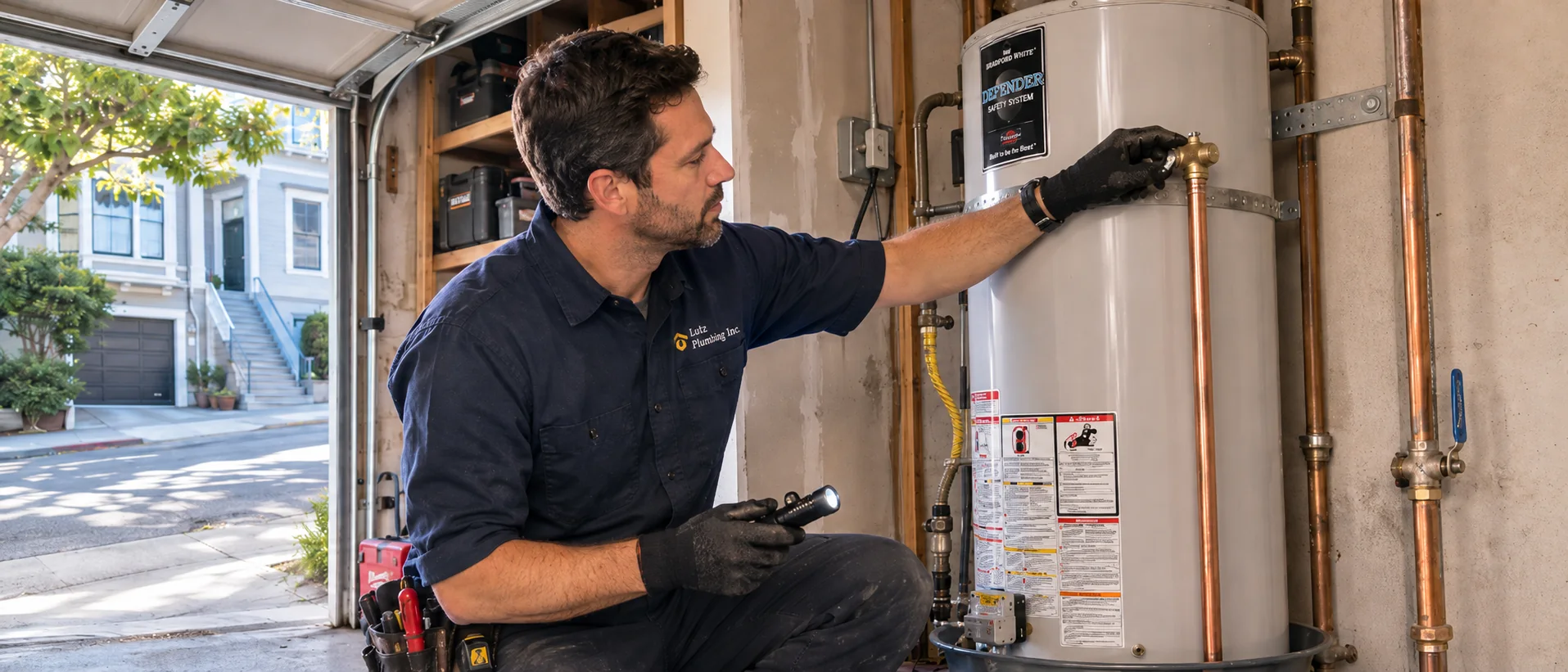
Leaking tank, no hot water, or a pilot that will not stay lit? Lutz diagnoses, repairs, and replaces tank, tankless, gas, electric, and heat pump water heaters. Serving San Francisco since 1929, with permitted, seismic-strapped replacements and a whole-system check.
Quick answer
Yes, we repair and replace water heaters in San Francisco.
Lutz Plumbing diagnoses tank, tankless, gas, electric, and heat pump water heaters. A failed control, burner, element, valve, or connection may be repairable when the unit is otherwise sound. A leaking tank body, unsafe venting, or a unit whose condition makes another repair poor value usually points to replacement. We test first, explain the finding, and give you a written recommendation.
Help us prepare for the visit
- Describe the symptom and when it started
- Include the fuel type, brand, model, and age if known
- Send a full-unit photo plus a close-up of any leak or error code
Fast help for common water heater problems
Tell us what is happening. We will tell you what it means.
Most water heater calls come down to one of a handful of patterns. Find yours below, or just call, we pick up the phone Monday through Friday 8 to 4:30 and roll an after-hours emergency truck when it matters.
Water heater leaking
A puddle under the tank is a signal to act now. We confirm the source (fittings, relief valve, or the tank body itself), make the unit safe, and tell you honestly whether a repair is sensible or the tank has failed and needs to be replaced.
No hot water
On a gas unit this is usually a failed thermocouple, burner, or gas control. On electric it is commonly a heating element or thermostat. We diagnose the actual fault before any parts go in, so the fix holds.
Pilot light keeps going out
A pilot that will not stay lit is almost always a thermocouple, dirty burner, or a venting problem starving the flame of combustion air. Common in older San Francisco closet installs. We fix the underlying cause, not just the symptom.
Running out of hot water too fast
Sediment buildup in older tanks, a broken dip tube, or a unit that was undersized for the household all present the same way. We test recovery and storage before recommending a flush, a repair, or an upsize.
Rusty or discolored hot water
Rusty water points to either a corroded tank interior or, in pre-1960s SF homes, aging galvanized supply lines feeding the heater. We locate the source and separate a tank problem from a piping problem so you do not pay for the wrong fix.
Popping, rumbling, or kettling noises
Sediment on the tank bottom overheats and flashes water to steam under the deposit. A flush helps early; once the tank is scaled heavily and the steel is stressed, replacement is the safer call.
TPR valve discharging or drip pan filling
The temperature and pressure relief valve doing its job is a safety signal worth investigating the same day. We check incoming pressure, expansion control, and relief routing, then correct the root cause so the valve is not papering over a hidden problem.
Water too hot or temperature swings
Thermostat drift, a failed mixing valve, or an incorrectly set tank can scald or cycle unpredictably. We verify temperatures at the tank and at the tap, then set the system to code-correct scald-safe operation.
Repair or replace
Sometimes the right answer is a part. Sometimes it is a new unit. We will tell you which.
A twelve-year-old tank with a seeping seam gets a different answer than a six-year-old unit with a failed thermocouple. We have been doing this long enough to know when a repair will hold and when it will not. If the honest answer is replacement, we say so, and if a repair is the right call, we say that too. Nobody leaves here with a new tank they did not need.
Every recommendation is written down, with the reasoning behind it, so you can make the call with clear information.
What we install
Matched to the building, not just the spec sheet.
We install tank, tankless, and heat pump systems from the manufacturers we trust to hold up in San Francisco homes. The right choice depends on the closet, the gas line, and how you actually use hot water. Not the label on the front of the box.
Traditional tank water heaters
The right answer for many San Francisco homes, especially when the closet or venting cannot support a tankless conversion. We match equipment to the building, not just the spec sheet on the front of the box.
Homes with an existing tank footprint, straightforward venting, and hot water demand a correctly-sized tank can meet.
Tankless and on-demand water heaters
Endless hot water in a fraction of the footprint, but only when gas capacity, venting, and maintenance access are planned correctly. We verify all three before we recommend a conversion.
Homes with adequate gas supply, a good vent path, and hot water demand that justifies the install. Strong candidate for remodels opening up walls.
Heat pump (hybrid) water heaters
Two to three times the efficiency of a gas tank when the location has enough ambient heat and airflow. We evaluate the space, condensate routing, and electrical panel capacity before we quote.
Garages, basements, and utility rooms with airflow and an electrical panel that can take the load. Worth the conversation when the existing tank is failing.
We service other makes as well, and we will tell you candidly when a repair on a brand we did not install is safe and sensible.
The Lutz standard
A whole-system check, not just a tank swap.
Most water heater calls fail later because the install ignored the system around the tank. We look at the venting, the gas supply, the pressure, the piping, and the seismic strapping on every job. That is what doing it right looks like in a San Francisco home.
Closet installs with tight venting
Most San Francisco water heaters live in a hall closet, a basement cubby, or a garage corner with very little room to work. Proper combustion air, correct vent slope, and adequate clearances are not optional. We evaluate all three before we write the job.
Seismic strapping
California requires two seismic straps on tank water heaters: one in the upper third and one in the lower third, braced to the structure. Every Lutz replacement meets current seismic strap code before we leave.
Galvanized supply lines in older homes
Pre-1960s homes often still feed the water heater through original galvanized steel. We inspect the transition and tell you honestly when the rust-colored hot water is coming from the piping, not the tank. A new tank will not fix bad supply line.
Expansion tanks and pressure control
A check valve, pressure-reducing valve, or similar device can create a closed plumbing system. Without working expansion control, pressure spikes can shorten heater life and push the TPR valve to discharge. We check the pressure and expansion setup on every replacement.
Gas capacity for tankless conversions
Tankless water heaters draw 150,000 to 199,000 BTU on demand, far more than a tank. The gas line and meter have to support that load. We size the gas capacity first, then decide if tankless is the right recommendation for your home.
Permits and inspection
Replacement of a gas water heater in San Francisco requires a permit. We pull it, install to current code, and hand the signed paperwork to you at the end of the job.
How we work
Diagnose, recommend, install to code, walk you through it.
The same crew from diagnosis to commissioning, and the same phone number if you need us back.
Diagnose honestly
We evaluate the actual fault before quoting anything: pressure, combustion, venting, gas supply, and the condition of the tank. A repair that will not hold is not the right repair.
Recommend plainly
You get a written scope and a clear repair-or-replace recommendation. Simple jobs get a fixed price. Complex installs get a scope plus how we will handle anything we uncover, so there is no surprise invoicing.
Install to code
Permitted, seismic-strapped, properly vented, with expansion control and a clean relief discharge routed where it is supposed to go. The whole system around the heater, not just the tank.
Walk you through it
We commission the unit, walk you through the controls, and hand you the paperwork. If it is not right, we come back on our dime.
Common questions
Answers to the questions we get on water heater calls.
How do I know if my water heater needs repair or replacement?
If the leak is at a fitting, the pilot or thermostat has failed, or sediment is causing noise, repair is often the right call. If the tank body itself is leaking, the unit is past 10 to 12 years old, or venting and combustion air are unsafe, replacement is the safer option. We diagnose on site and tell you honestly which way to go.
My water heater is leaking. What should I do right now?
Shut off the cold water supply to the heater (the valve on top), shut off the gas or breaker, and call us. Do not wait for the leak to get worse. A leaking tank rarely fixes itself, and a gallon of water an hour becomes damage fast in a San Francisco closet.
How long do water heaters last in San Francisco?
Traditional tank water heaters commonly last 8 to 12 years, tankless units 15 to 20 with annual maintenance, and heat pump units 10 to 15. San Francisco water is moderately hard, so annual flushing meaningfully extends tank life.
Do you pull permits for water heater replacement in San Francisco?
Yes. Gas water heater replacement in San Francisco requires a permit. We pull it, install to current plumbing, mechanical, and seismic code, and hand you the signed paperwork when we are finished.
Can you install a water heater in a tight closet?
Yes, and most San Francisco installs are exactly this. The important details are combustion air, vent slope and clearance, seismic strapping, and access for future service. We evaluate all four before we commit to a closet install.
Can I put a tankless water heater in my Victorian or Edwardian home?
Often, yes. The two questions are whether the gas line can support the higher BTU draw and whether a safe vent path exists. We verify both before we recommend a conversion. If tankless is not right for the building, we will say so.
Why is my hot water rusty or brown?
Rusty hot water is usually either internal tank corrosion or deteriorating galvanized supply line, common in pre-1960s San Francisco homes. The fix is different for each, and swapping the tank will not resolve a piping problem. We separate the two on site.
What is seismic strapping and is it required?
California requires two seismic straps on tank water heaters, one in the upper third and one in the lower third, braced to the structure. Every Lutz replacement meets current seismic strap code before we leave the property.
Do you service water heaters you did not install?
Yes. We repair and service the full range of major brands, including Bradford White, A. O. Smith, Rheem, Rinnai, Navien, and Noritz, regardless of who originally installed the unit.
How often should I service my water heater?
We recommend an annual inspection. Flushing or descaling depends on the unit, manufacturer guidance, and what we find. San Francisco's regional water supply is generally soft, so we do not apply a generic hard-water maintenance schedule to every heater.