
Leak detection · San Francisco
Leak detection in San Francisco: find the leak first, then repair it.
Water stains, a damp baseboard, a rising SFPUC bill, or a Leak Alert notification usually mean a hidden leak somewhere in the supply piping. Lutz Plumbing locates the leak precisely with acoustic, thermal, pressure and camera testing, then repairs what it finds.
Lutz Plumbing Inc., San Francisco's oldest plumbing company, in business since 1929, locates and repairs hidden water leaks for homes and buildings across San Francisco.
Quick answer
How do you find a hidden water leak in a San Francisco home?
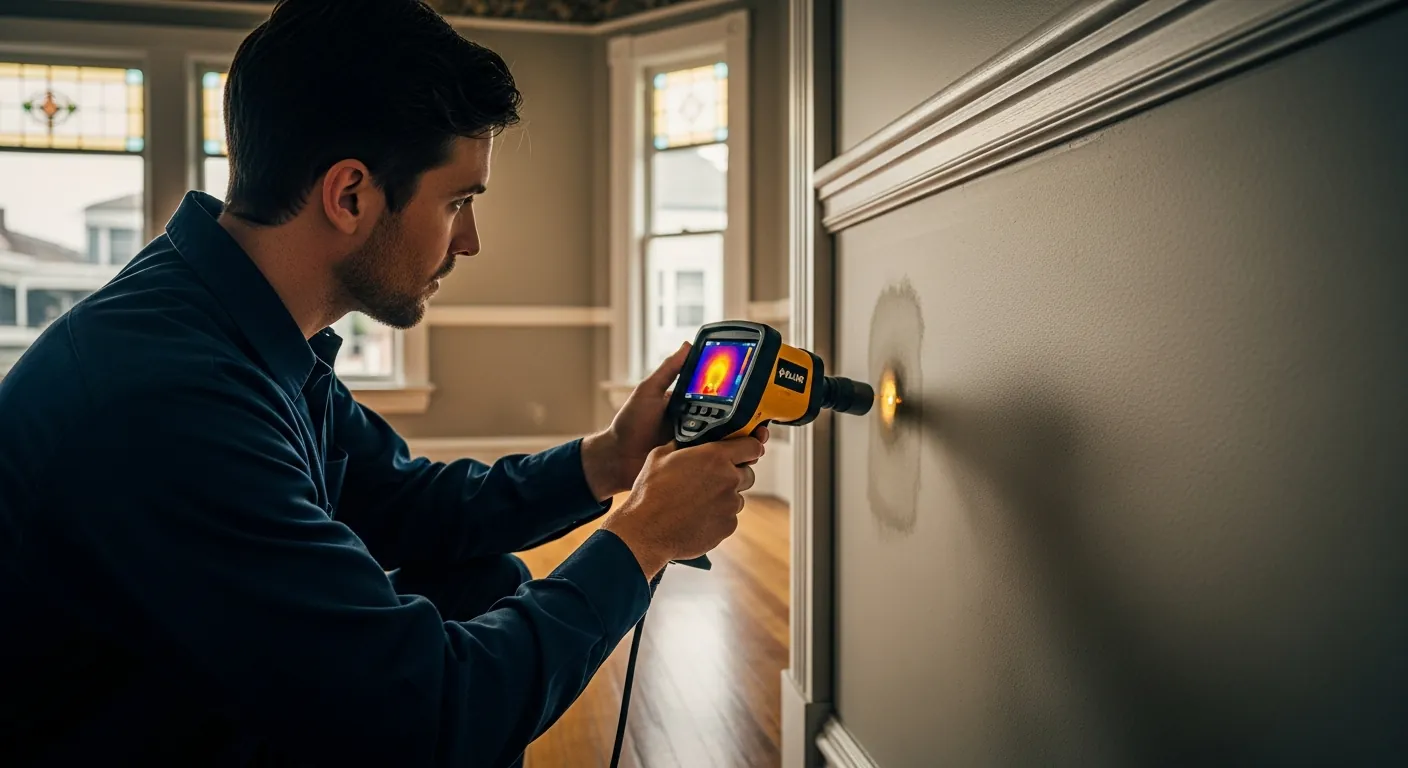
Lutz Plumbing finds a hidden water leak by testing, not by opening walls on a guess: a pressure test confirms the system is losing water, acoustic equipment and a thermal camera trace the leak to a spot, and where the line allows it a camera inside the pipe confirms the source. The repair then starts from a marked spot.
In San Francisco homes built before 1960, from the Mission to Cow Hollow, the usual causes are a pinhole in galvanized steel pipe, a slab leak (a pipe leaking under a concrete floor), or a drip coming through original plaster from a fitting one floor up.
Water running right now?
Close the main shutoff if you can reach it safely (usually in the basement, crawlspace, under the front stairs, or at the street meter), then call (415) 621-4292. Our office answers Monday to Friday, 8:00 AM to 4:30 PM. After hours, leave a voicemail and a dispatcher calls back for genuine emergencies.
Emergency plumbing in San FranciscoThe signs of a hidden water leak usually show up before the damage does.
A water bill that climbs, or a meter that moves with everything off
Same household routine, higher bill, or a meter still turning with every fixture and appliance off: water is leaving the system somewhere past the meter, in the piping or in a fixture such as a running toilet.
An SFPUC Leak Alert notification
A Leak Alert means the utility has flagged your account for a possible leak; it does not say where, and locating it is the part Lutz handles.
A stain, bubbling paint, or a soft spot on a ceiling or wall
A stain that grows or returns after drying points to an active leak, often a pipe or fitting above it, sometimes a floor up.
Mildew, a musty smell, or a damp baseboard
Moisture behind plaster or under a floor feeds mildew long before water becomes visible.
A warm patch on a concrete floor, or running water heard when nothing is on
A warm patch often points to a slab leak on a hot water line; the sound of running water means water is escaping somewhere, sometimes under the slab.
Water pooling where there is no fixture
Water at the base of a wall, in a garage, or along a foundation with no fixture nearby has a source that needs finding, not just mopping.
Leak detection methods: pressure, acoustic, thermal and camera testing
Walkthrough and static pressure test
We start with where the water shows, what the bill or Leak Alert says, and the age and material of the piping, then run a static pressure test to confirm the system is losing water.
Acoustic listening
Acoustic listening equipment picks up the sound of water escaping a pressurized pipe through plaster, wood, and concrete, which is how a pinhole inside a wall or a slab leak is traced to a spot.
Thermal imaging
A thermal imaging camera shows temperature differences across a wall, floor, or ceiling, so a hot water leak or a wet patch of plaster appears on the screen before it appears as damage.
Video pipe inspection
Where the line allows it, a camera inside the pipe confirms the source before anything is opened up.
A marked location and a written quote
You get the location, what we found, and a written quote before any repair starts.
The repair, with the finishes in mind
Lutz Plumbing repairs wall, ceiling, and foundation leaks and works to preserve original plaster and wood.
When the water is not a hidden supply leak
A puddle under the water heater is usually a tank, fitting, or relief valve problem, not a hidden pipe leak; the water heater page covers that diagnosis and the repair-or-replace call.
When a galvanized system has leaked in several places, a copper or PEX (flexible plastic) repipe is often the better long-term answer, and it has its own page.
Water coming up from a drain or toilet is a drain or sewer problem; start with drain cleaning, or the sewer line page if the camera shows a damaged sewer line.
A gas smell is not a water leak: leave the building, then call 911 and PG&E at (800) 743-5000 from outside, before you call a plumber.
What affects the cost of leak detection and repair?
After we diagnose on site, you get a written quote before any work begins; simple jobs get a fixed price and complex ones get a clear scope plus how we handle anything we discover along the way.
Common questions
I got an SFPUC Leak Alert. What should I do?
Keep the notification and have the leak located: a Leak Alert means SFPUC has flagged your account for a possible leak, not where it is. Lutz Plumbing locates the leak with pressure, acoustic, and thermal testing, repairs it, and helps with the Leak Allowance paperwork.
Will the wall have to be opened to repair the leak?
Usually yes: the repair starts from the spot that testing has marked, instead of from exploratory openings. Lutz Plumbing works to preserve original plaster and wood around the repair, and you get a written quote before the repair starts.
Is a high water bill always a leak?
No, a high water bill is not always a hidden leak: irrigation, an outdoor faucet left on, a new appliance or a change in household use can raise it, and a running toilet is a fixture leak, not a hidden one. Rule those out, then check the meter with everything off; if it moves, a hidden leak needs locating.
What is a slab leak and how do you find one?
A slab leak is a leak in a water line running under a concrete floor, often under a garage or a ground-floor addition. We confirm it with a pressure test, trace it with acoustic listening equipment and a thermal camera, and mark the spot, so the repair starts from a known location instead of guesswork.
Do you repair the leak once you find it?
Yes, Lutz Plumbing repairs the leaks it finds, so detection and repair come from one company with one written quote before the work starts. If a galvanized system keeps developing pinhole leaks, we give a clear recommendation on repiping with copper or PEX.
How much does leak detection cost in San Francisco?
The cost of leak detection in San Francisco depends on access, how much of the system has to be tested, and what has to be opened to reach the leak. After diagnosing on site, Lutz Plumbing gives you a written quote before any repair starts.
Have the leak located before anything is opened.
Send us where the water shows, when it started, a photo of the stain or of the SFPUC notification, and the age of the building if you know it. We answer Monday to Friday, 8:00 AM to 4:30 PM. After hours, leave a voicemail and a dispatcher calls back for genuine emergencies. Once the leak is repaired, a smart water shutoff valve can close the main automatically next time; see our guide to smart water shutoff valves and insurance.